Statistics
Seventeen panels over your whole review history: what you studied, how it went, and what's coming. Open it with the Stats button on the dashboard, or run Open statistics from the command palette.
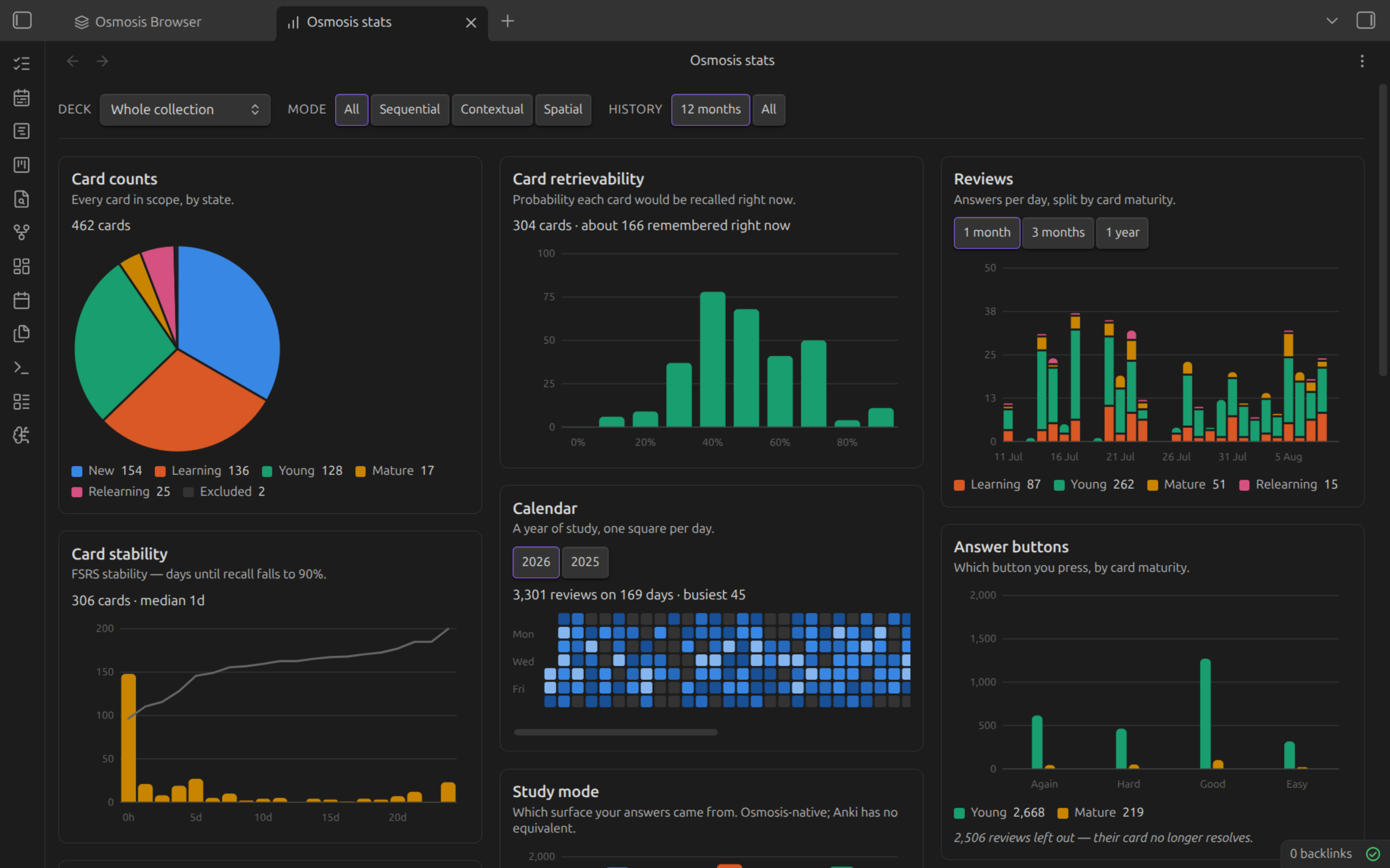
Scope
Three controls at the top apply to every panel at once:
| Control | Values |
|---|---|
| Deck | Whole collection, or any single deck and its sub-decks |
| Mode | All, Sequential, Contextual, Spatial |
| History | 12 months, or All |
Panels that plot volume over time carry their own range picker — 1 month (daily bars), 3 months (weekly, Sunday-aligned to match the heatmap), or 1 year (monthly).
New cards leave the state graphs under a mode filter
A card carries no study mode of its own — reviews do. So filtering by mode restricts card-state panels to cards with at least one review on that surface, and an unstudied card was not studied contextually.
The Panels
Right now
| Panel | Shows |
|---|---|
| Today | What you've studied today, whatever the history scope says |
| Future due | Cards coming up, by day — your scheduling load |
| Calendar | A year of study, one square per day |
Volume
| Panel | Shows |
|---|---|
| Reviews | Answers per day, split by card maturity (learning / young / mature / relearning) |
| Review time | Time on screen per day |
| Hourly breakdown | When you study, and how it goes |
| Answer buttons | Which button you press, by the maturity each card had when you answered it |
The collection
| Panel | Shows |
|---|---|
| Card counts | Every card in scope, by state — including an Excluded slice |
| Review intervals | How far out cards are scheduled |
| Card stability | FSRS stability — days until recall falls to 90% |
| Card difficulty | FSRS difficulty, 1 (easiest) to 10 |
| Card retrievability | Probability each card would be recalled right now |
Retention
| Panel | Shows |
|---|---|
| True retention | Pass rate on mature reviews (interval ≥ 21 days) — the headline retention number |
| Study mode | Which surface your answers came from — unique to Osmosis |
| Recall by study mode | Does studying in the note that taught you beat drilling out of context? |
| Recall by card type | Which authoring style works: Basic / Bidirectional / Cloze / Code cloze / Line |
| Weakest notes | Worst recall first, minimum 5 graduated reviews, top 10 — an editing worklist |
Two different maturity bars, on purpose
True retention uses the conventional 21-day mature bar. The three recall panels use a 1-day graduated bar instead — slicing mature-only reviews four ways leaves samples too thin to compare, and one day is the lowest threshold that still excludes same-session learning-step answers. Each caption says which it's using.
Rearranging Panels
Drag a panel by the grip in its top-left corner to move it. The order is saved, and works with a mouse or by touch. New panels in a future release append at the bottom rather than reshuffling an arrangement you made.
Where the Numbers Come From
Every graph reads the review log — an append-only history of every answer you've ever given, stored as Markdown in your vault. Card-state panels (counts, stability, difficulty, retrievability, future due) read your cards' current schedules instead.
Two consequences worth knowing:
- Reviews of deleted cards still count at whole-collection scope. Under a deck scope they drop out, because a review joins to a deck only through its card — which no longer exists.
- Whole collection is instant; a narrower deck scope re-reads the log, so it takes a moment on a long history.
Excluded cards are counted, not hidden
Cards you've excluded from study show as Excluded in Card counts. Cards merely kept out of decks count normally by state — they're still actively studied in place.